
Science
Clever Beasts: Animal Intelligence and the Surprising Reach of Tool Use
Crows that bend wire into hooks and octopuses that carry shelters reveal that sophisticated problem-solving is far more widespread than once believed.
From insects that mimic dead leaves to cephalopods that change their skin in an instant, camouflage is nature's most refined visual deception.
Survival in a world full of hungry eyes often comes down to a single imperative: not being seen. Camouflage, the art of blending into the surroundings or confounding the eye of an observer, is among the most elegant products of evolution. It appears in nearly every habitat and across every major group of animals, and the more closely biologists examine it, the more sophisticated it proves to be. What looks at first like simple colour-matching turns out to involve several distinct strategies, each exploiting a different quirk of vision.
The most familiar form is background matching, in which an animal's colour and pattern resemble its typical surroundings. A moth resting on bark, a flatfish against the seabed, a hare in its summer coat, each dissolves into its environment because its appearance echoes what lies behind it. More striking still is masquerade, in which a creature mimics not the general background but a specific, uninteresting object. Stick insects impersonate twigs, certain caterpillars resemble bird droppings, and leaf insects reproduce the veins, blemishes and even the ragged edges of foliage with uncanny fidelity.
Colour-matching alone is not enough, because the eye is adept at detecting the tell-tale outline of a body. Many animals therefore employ disruptive coloration, bold patches and stripes that cut across the body's shape and prevent the viewer's brain from assembling it into a recognisable whole. The boundary of the animal is broken up so thoroughly that it is lost against the clutter of the background. This explains why so many well-camouflaged creatures are not uniformly drab but boldly marked; the markings serve to fragment the form rather than to match any particular surface.
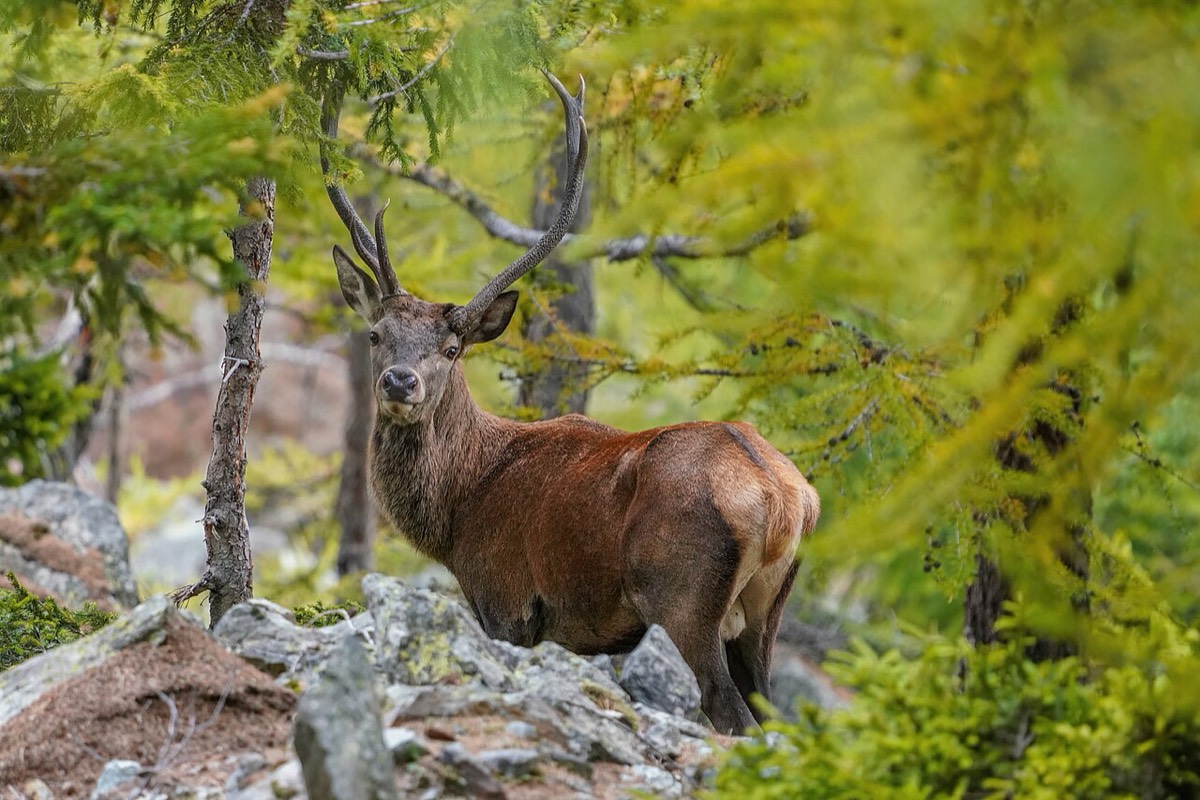
Another widespread technique addresses the problem of shadow. Light falling from above makes an animal's underside darker and its back lighter, a gradient that betrays its solid, three-dimensional shape. Countershading reverses this effect: the animal is darkest on top and palest beneath, so that the natural shading cancels out and the body appears flat and insubstantial. From sharks to deer to countless fish and birds, this subtle arrangement of tone is one of nature's commonest disguises.
The supreme masters of concealment are the cephalopods, the octopuses, cuttlefish and squid. Their skin is studded with pigment-filled cells that expand and contract under nervous control, along with reflective layers that manipulate light, allowing the animal to transform its colour and pattern within a fraction of a second. A cuttlefish can match the mottled texture of a rocky seabed one moment and the pale smoothness of sand the next, and some can even raise the texture of their skin into ridges and bumps to mimic the three-dimensional structure of their surroundings. Remarkably, they achieve this despite evidence that they are colour-blind, apparently judging their background through other means.
Camouflage is never static in the evolutionary sense either. Predators and prey are locked in a perpetual arms race, each improvement in concealment met by sharper vision or new hunting tactics, which in turn drives the refinement of the disguise. Some animals even combine strategies with the seasons, moulting from a summer coat that matches bare ground to a white winter coat that matches snow, shifting their camouflage as the landscape changes around them.
To study camouflage is to study the nature of seeing itself, for every disguise is tailored to exploit the perceptual machinery of a particular viewer. An animal hidden from one predator may be conspicuous to another whose eyes work differently. In this sense camouflage is a conversation conducted in light, a quiet, continuous negotiation between the hunter and the hunted, and one of the clearest demonstrations that beauty in nature is so often a matter of life and death.
Crows that bend wire into hooks and octopuses that carry shelters reveal that sophisticated problem-solving is far more widespread than once believed.
From migrating songbirds to ocean-crossing turtles, countless animals read an invisible map written in magnetism, and science is only beginning to understand how.
Bringing a second cat into the home works best as a patient, scent led process that lets both animals adjust at their own pace.